What Is a Tented Camp? Every Type of African Glamping Stay, Explained
A tented camp is a camp where you sleep in a canvas-walled room with a proper bed and, at almost every private camp in Africa, your own bathroom. This guide defines every stay type on the continent, from permanent tented camps to fly camps, and says plainly what each one gets you.
If you have just been quoted $900 a night for a “camp” and you are trying to work out whether that means a sleeping bag or a suite, the answer is a suite. So what is a tented camp?
In African safari travel it is a property where the guest rooms have canvas walls and a canvas roof stretched over a rigid frame, standing on a raised platform, with a real bed inside and usually a full bathroom behind the back wall.
The confusion is not your fault. “Camp” is the most misleading word in African travel, used for a four-tent operation that packs down twice a year and for properties charging more per night than a five-star city hotel.
“Tented lodge”, “safari camp”, “bush camp” and “luxury tent” are marketing terms nobody polices.
This guide fixes the vocabulary, defining each type by what it is made of, whether it moves, and what comes with it.
So what is a tented camp?
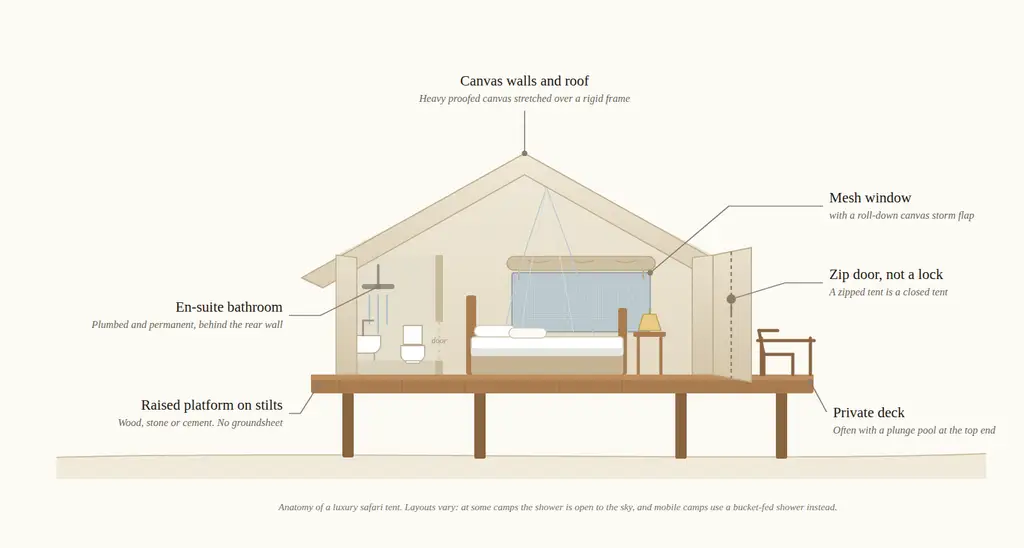
Strip away the marketing and a safari tent has five parts.
A rigid frame and a solid floor. The tent stands on a platform of wood, stone or cement, usually raised on stilts. You are not sleeping on the ground and there is no groundsheet.
Canvas walls and roof. Heavy proofed canvas, not nylon, stretched taut over the frame rather than pegged out.
Mesh windows with canvas storm flaps. The windows are gauze panels you can see and hear through, with canvas covers that roll down for weather and privacy. This is why a tent feels open when nothing about it is.
A zip door. Not a lock. On this point the industry is straightforward: a zipped tent is a closed tent, and closed tents are left alone.
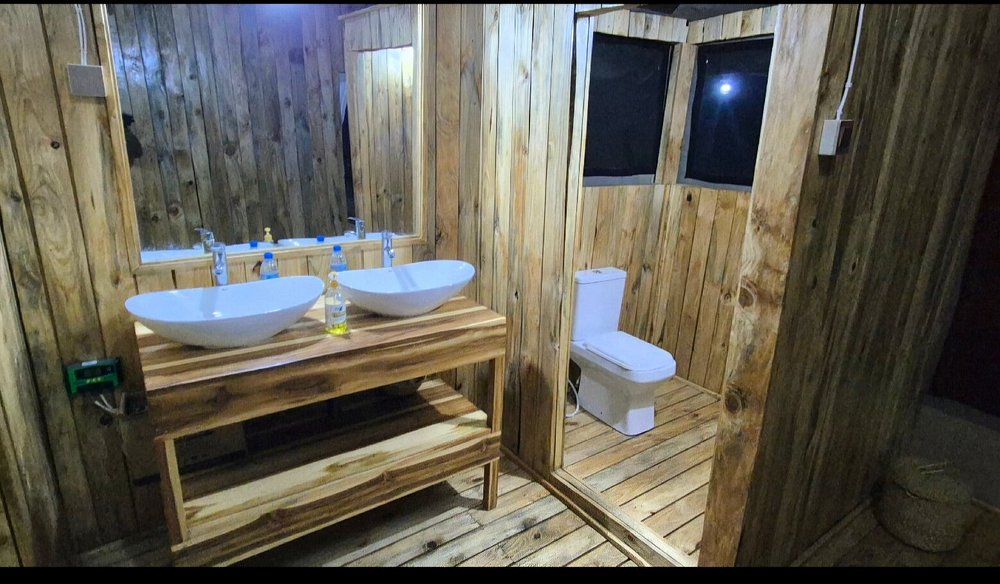
A bathroom. At private camps this sits behind the rear canvas wall, plumbed and permanent, with a flushing toilet and a hot shower. Some are open to the sky. At budget national-park units this part varies, and it is the detail worth checking hardest.
The canvas is the point, not a cost saving. It transmits sound and temperature, which is what people are paying for: hippos grazing past at two in the morning, rain drumming overhead, the cold arriving the moment the sun goes.
It also lets camps build where permanent walls are not permitted, which is why the best-placed properties in East and Southern Africa are so often under canvas rather than thatch.
Say the trade-off plainly, because it decides the trip for some people. Most guests find it thrilling; a minority do not sleep. If you are the second kind, the domes, treehouses and lodges below exist for you.
Permanent, seasonal, mobile: the distinction that matters most
Forget the adjectives. The one structural question is whether the camp stays where it is.
Tanzania’s park authority is unusually clear about this, and its categories are the most useful definitions published anywhere. TANAPA licenses a permanent tented camp as “one level, cement or wood platform, tented structure” with its own reception and dining facilities.
A seasonal campsite is a “temporary tented camp set in one place for at least one season (3 months) with no concrete platform or permanent toilet structures”. A special campsite takes “one group at a time, no concrete platforms or permanent structure of any type”.
A fly campsite is what it sounds like: you walk in with an armed guide and sleep where you stop. A lodge is defined by “permanent, steel reinforced cement foundations with permanent hard walls”.
That hierarchy explains almost every price and comfort difference you will meet.
A working example. Asilia’s Olakira Migration Camp runs as two seasonal camps under one name: it sits in the Ndutu area from December to March, then moves north to Bolongonja near Kogatende airstrip from June to October.
Ten tents plus two family units in the north, nine plus one in the south, en suite with solar-heated hot-water showers, running on solar with a backup generator. It closes entirely in April, May and November.
Angama Safari Camp in the Maasai Mara works differently again: four en-suite tents for up to eight guests, sold only on an exclusive-use basis, moving between sites within the Mara Triangle.
The practical consequence is that a seasonal camp is shut for part of the year, so a date that works for a lodge may not exist as an option at all.
Every type of African glamping stay
| Type | What the walls are | Bathroom | Typical size | Best for | |
| Tented camp | Canvas on a fixed platform | En suite, plumbed | 4 to 12 tents | The classic safari experience | |
| Luxury tent / tented lodge | Canvas, sometimes with wood or glass | En suite, often an outdoor shower too | 6 to 20 tents | Comfort without losing the canvas | |
| Safari tent (national park) | Canvas on stilts | Varies: private shower or shared ablutions | Dozens of units | Self-drive and budget travellers | |
| Mobile / seasonal camp | Canvas, no concrete | En suite, often bucket-fed | 4 to 12 tents | Migration and remote wilderness | |
| Fly camp | Light canvas, one or two nights | Bucket shower, short-drop toilet | 2 to 6 tents | Walking safaris, repeat travellers | |
| Bush camp | Canvas or thatch, small and remote | En suite, often open-air | 3 to 6 units | Walking-first, low-volume safaris | |
| Star bed / sleep-out | Open frame or open-fronted tent | Outdoor, open to the sky | 1 unit | One night, honeymoons, stargazing | |
| Safari lodge | Brick, stone, timber, thatch | En suite | 8 to 30 rooms | Air-con, families, light sleepers | |
| Treehouse | Timber, elevated | En suite | 1 to 8 units | Views, novelty, couples | |
| Glamping dome | Rigid geodesic frame, PVC and glass | En suite | 2 to 12 domes | Insulated comfort, domestic getaways | |
| Houseboat | Steel hull, cabin walls | En suite | 8 to 14 cabins | River game viewing, Chobe and Zambezi | |
| Bush house / villa | Solid walls, exclusive use | En suite | 1 house, 3 to 6 rooms | Families and groups |
Property counts and price ranges are the live “from” rates listed on GlampingInAfrica.com, checked August 2026. Rates move constantly, so treat them as bands rather than quotes.
The canvas stays, explained
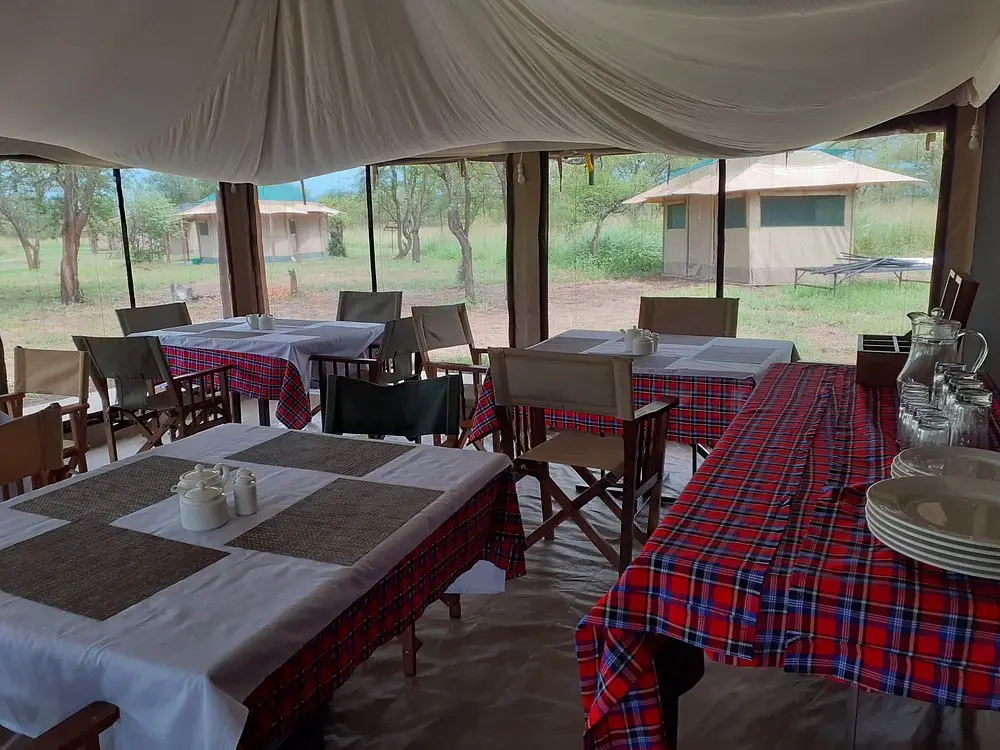
1. The tented camp
The reference type. Canvas rooms on fixed platforms, a communal dining and lounge area, usually under twelve tents, and a rate that almost always includes meals and game drives.
Garonga Safari Camp in the Greater Makalali reserve is a fair measure of the category: six luxury en-suite units, a sleep-out deck twenty minutes from the main camp with a four-poster bed, and a semi-covered star bath open to the night sky.
Dwyka Tented Lodge sits in a dry riverbed in the malaria-free Sanbona reserve, about three hours from Cape Town. Both are canvas. Neither is roughing it.
See our tented camps, including Garonga Safari Camp.
2. The luxury tent, or tented lodge
The same structure with more of everything: a larger footprint, air conditioning or fans, a plunge pool on the deck, an indoor and an outdoor shower. The premium is rarely about the canvas.
It buys land access, low guest density, and how few other vehicles reach a sighting.
The label stretches, though. Wolwedans Dunes Lodge in Namibia’s NamibRand reserve is listed under luxury tents and is genuinely canvas-walled, but the structure is a wooden chalet on stilts whose canvas blinds form the wall panels and roll up for the view. That is a fair use of the term. Others are looser.
Browse our luxury tents.
3. The safari tent in a national park
The budget end, and the one most likely to surprise you.
South African National Parks runs canvas units across Kruger and several other parks, and its glamping guide describes Lower Sabie’s safari tents as “24 two-bed permanent furnished canvas tents on stilts” with two single beds, a fridge, an overhead fan and a small veranda, and Tamboti’s as “ten semi-luxury three-bed safari tents on stilts” with a shower, fridge, cooking and braai facilities.
Read those two descriptions again. One lists a shower. The other does not. That is the whole warning: at this end of the market some units are en suite, some share an ablution block, and some are self-catering with no meals at all.
SANParks quotes unit rates on request rather than publishing them, so ask for the unit type by name and check the park’s accommodation list first. See our Kruger National Park guide.
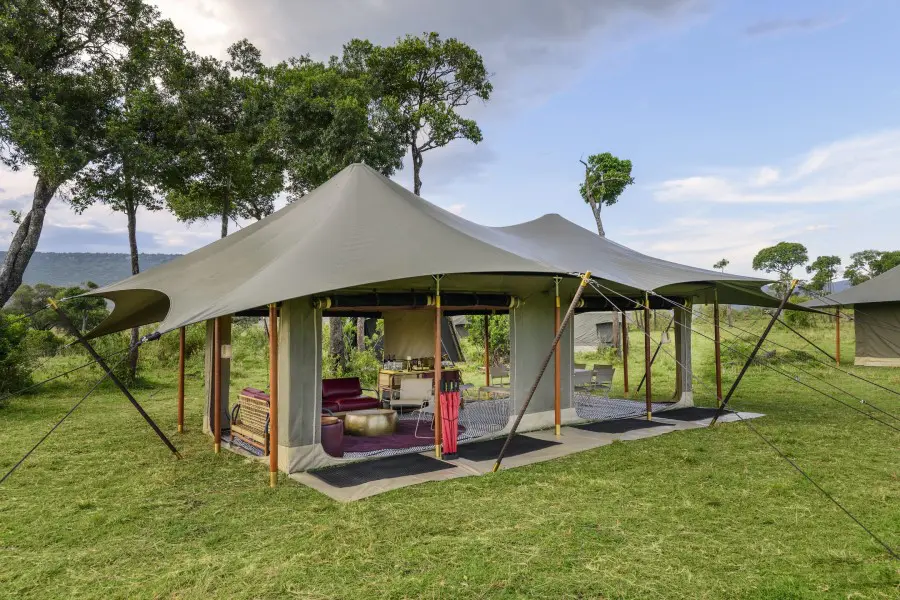
4. The mobile or seasonal camp
Canvas, no concrete, and a location chosen by where the animals are that month.
Comfort sits higher than the name suggests and lower than a permanent camp: a proper bed and an en-suite bathroom, hot water that is solar or bucket-fed, and a generator schedule rather than round-the-clock power.
Browse our Tanzania properties.
5. The bush camp
Small, remote and walking-led rather than vehicle-led. Zambia’s South Luangwa is the home of the format, where camps run to three to five units apiece and are strung together as a walking circuit: Chindeni has four elevated tents, Kuyenda five thatched chalets.
Structures are a mix of canvas and thatch, and the building is not the point. Leaving on foot with an armed guide is.
Browse our walking safari camps.
6. The fly camp
The most stripped-back type still sold as a paid experience, and usually an add-on rather than a stay in its own right. Asilia describes its fly camping tents as having windows on three sides and a veranda with an awning, a foam mattress and proper linen, a hot bucket shower hung in a tree, and a short-drop toilet.
Stays are typically one night, walked in with an armed guide.
Do not book this as your first night under canvas. Book it on night four, once you know how you sleep out here.
7. The star bed and the sleep-out deck
One night, no walls, and the most photographed thing in the category.
Tswalu’s Malori sleep-out in the Kalahari is a classic safari tent elevated above the dunes, lit by lantern because there is no electricity, with an outdoor bathroom open to the sky: flush toilet, basin and hand-held shower.
Staff serve dinner and then leave.
That last detail is the one to sit with. Nobody stays. For most couples that is the appeal, and if it is not, say so when you book, because these are sold as an upgrade you can decline.
See our romantic properties.
The stays that are not canvas at all
Safari lodges. Solid walls of brick, stone, timber or thatch, with air conditioning, insulation and near-silence. Those matter more than people expect for light sleepers, small children and anyone travelling in a Lowveld summer. Browse our safari lodges.
Treehouses. Elevated timber structures, usually one to eight units, sold on the view. Sanctuary Baines’ Camp in the Okavango Delta is the archetype, with suites on stilts above the floodplains. Browse our treehouses.
Glamping domes. A rigid geodesic frame with a panoramic window: insulated, weatherproof, structurally the opposite of canvas. Almost all of Africa’s domes sit on farms, in the Cape winelands and on private land rather than inside Big Five reserves, so treat them as a getaway format rather than a safari one.
Houseboats. The game-viewing platform that moves. The Zambezi Queen works the Chobe River with fourteen cabins across three levels, air-conditioned, with front-facing balconies and en-suite bathrooms.
Bush houses and villas. A whole house on exclusive use, often with your own guide, vehicle and chef. The most economical way to travel as six or eight, and the only format that reliably gives you a kitchen. Browse our bush houses.
One-off conversions. A small but real category. Kruger Shalati is a train permanently positioned on the Selati Bridge over the Sabie River inside Kruger, with 24 carriage suites on the bridge and seven Bridge House suites beside it. Browse our unique and unusual stays.
What “tented lodge” and “safari camp” really mean
Nothing legally binding, outside the park systems that license structures.
Tented camp is the most reliable of the three. It nearly always means canvas rooms on platforms.
Tented lodge usually means a tented camp with lodge-grade infrastructure: bigger rooms, air conditioning, a pool, a spa, mains or full solar power. Sometimes it means a lodge with canvas detailing and solid walls behind it.
Safari camp means almost nothing on its own. It is applied to four-tent mobile operations and to properties charging $3,000 a night.
So ignore the noun and ask three questions before you pay a deposit. What are the walls made of? Is the bathroom inside the room, or is it a shared block? Does the camp move, and is it open on my dates?
Any reservations team answers all three in one email, and those answers tell you more than the category name ever will.
Does private camps have bathrooms?
At private camps, yes, and they are better than the word “tent” suggests. Angama Safari Camp’s mobile tents have double-head showers with running hot water, flushing toilets and a separate w/c. Olakira’s seasonal tents are en suite with solar-heated hot-water showers.
Three things to know about the plumbing.
- Bucket showers are not a downgrade. A canvas bucket is filled with hot water on request and hoisted above the shower head. You get roughly a normal shower’s worth, at the temperature you asked for. It exists because heating and pumping water in a camp with no mains is wasteful, not because anyone is cutting corners.
- Hot water is often on a schedule. Solar systems deliver best in the late afternoon and evening. Ask at check-in rather than at 5am.
- The budget end is where it varies. National-park safari tents may have a private shower, may share an ablution block, and may be self-catering. Check the unit description, not the camp description.
Most permanent camps run 24-hour electricity, increasingly solar, with wi-fi in the main area if not in the tents; seasonal camps limit charging to set hours. On locks, safari tents do not have them.
The zip is the closure, and camps in Big Five areas manage risk through protocol instead: escorts to and from tents after dark, no food kept in tents, and a briefing on arrival. The mechanism is worth understanding rather than taking on faith. Our first-time safari guide walks through the camp routine in full.
One health note. Many tented camps sit in malaria areas, and canvas is not a barrier. This is general information rather than medical advice, so confirm current guidance with a travel clinic before you travel.
Which should you choose?
- First safari, nervous about canvas? A permanent tented camp in a malaria-free reserve. Two nights is enough to learn whether canvas suits you.
- Light sleeper, small children, or travelling in summer heat? A safari lodge. Insulation and air conditioning are worth more than atmosphere on a hot night.
- Set on the Great Migration? A seasonal camp, booked around the months it is actually standing. Check closure dates before you book flights.
- Want to walk rather than drive? A bush camp in South Luangwa, with a fly camp added once you are settled.
- A group of six or more? A bush house on exclusive use, with your own guide and vehicle.
- One special night, or a getaway rather than a safari? A star bed added to a stay at the main camp, or a dome, treehouse or cottage within a few hours of home. Big Five is not the goal here and does not need to be.
Once you have picked a type, the next questions are where and what it costs.
Our guide to glamping in Africa covers the countries and price bands, and our glamping safari in South Africa guide narrows it to the easiest country to start in. When you are ready for real properties, browse every way to stay.
Frequently asked questions
What is a tented camp?
A tented camp is a safari property where the guest rooms are canvas structures on a raised wooden, stone or cement platform, with a real bed and, at almost every private camp, an en-suite bathroom.
Tanzania’s park authority licenses these as permanent tented camps, separate from lodges, which have hard walls on cement foundations.
What is the difference between a tented camp and a lodge?
The walls. A lodge is built of brick, stone, timber or thatch, and is insulated and quiet. A tented camp has canvas walls and mesh windows, so you hear and feel the bush.
Service, food and guiding are often identical, and many tented camps cost more than the lodges near them because of where they are allowed to stand.
What is a tented lodge?
A tented camp with lodge-level facilities: larger rooms, air conditioning or fans, mains or full solar power, often a pool and a spa.
The term is not regulated, so some properties described as tented lodges have solid walls with canvas detailing. Ask what the walls are made of before booking.
Do safari tents have toilets and showers?
At private tented camps, almost always: a flushing toilet and a hot shower behind the rear wall of the tent, sometimes with a second shower open to the sky. Mobile camps may use a solar-heated or bucket-fed shower, and fly camps a short-drop toilet.
National-park safari tents vary most, with some en suite and some sharing an ablution block.
Can animals get into a safari tent?
A zipped tent is treated as a closed structure and is very rarely investigated. Tents have no locks, and camps in Big Five areas manage risk through protocol rather than hardware: escorts after dark, no food kept in tents, and an arrival briefing.
Follow the rules and a tented camp carries much the same practical risk as a room with walls.
How much does a tented camp cost per night?
Tented camps listed on this site range from $615 to $1,300 a night and luxury tents from $180 to $850, checked August 2026. National-park safari tents in South Africa sit well below that; Okavango and Sabi Sand flagships well above.
Compare inclusions before numbers: most camp rates cover all meals and two daily game drives, which a room-only lodge rate does not.
1 thought on “What Is a Tented Camp? Every Type of African Glamping Stay, Explained”
Comments are closed.