
Where to stay in Moremi Game Reserve
Showing 1–12 of 51 glamping camps and lodges in and around the park.
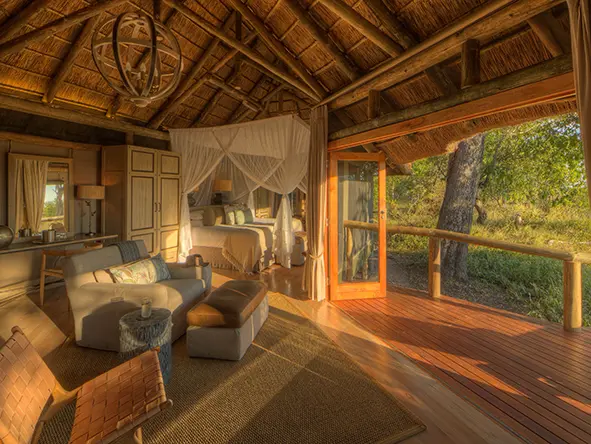
Camp Moremi

Camp Okuti

Camp Xakanaxa

Chitabe Camp

Chitabe Lediba

Chief’s Camp

Sanctuary Stanley’s

Belmond Eagle Island Lodge
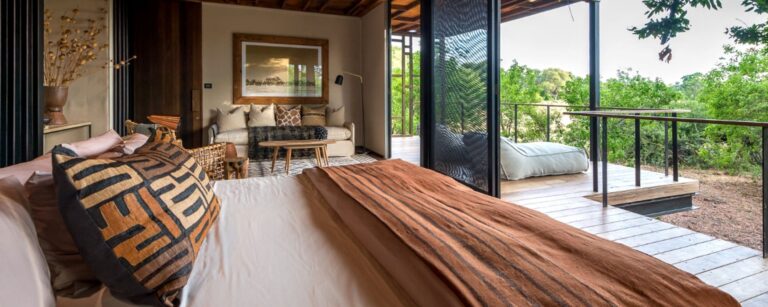
Qorokwe Camp
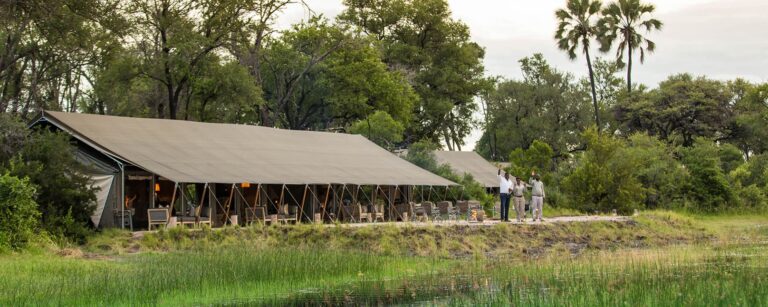
Gomoti Plains Camp

Vumbura Plains

Mombo Camp
Moremi Game Reserve guide
Overview
Moremi Game Reserve covers the eastern third of the Okavango Delta and is the only part of that vast wetland that is formally protected and publicly accessible. Roughly 5,000 square kilometres of floodplain, papyrus channel, mopane woodland and palm-studded island, it is the reserve most people mean when they say they are going to the Delta.
Moremi matters for a reason beyond its wildlife. It was proclaimed in 1963 by the BaTawana people themselves, who acted to stop the collapse of game in their own territory — the first protected area in southern Africa created by an African community rather than imposed by a colonial government. It is named after Chief Moremi III, and the decision was driven by his widow, Mrs Moremi.
The reserve’s defining feature is water, and how much of it there is depends on rain that fell in the Angolan highlands months earlier. The Okavango flood arrives in the Delta around May to July — the middle of Botswana’s dry season — which produces the strange and wonderful situation of the landscape flooding at exactly the point when the surrounding country is at its driest. Game pours in.
The working areas are distinct. Chief’s Island, the largest landmass in the Delta, sits at the heart of the reserve and holds superb predator densities. Xakanaxa, on the lagoon of the same name, is the classic water-and-land combination and the base for most boat activity. Third Bridge and Khwai, on the north-eastern edge, are the accessible self-drive end of the reserve and among the best places in Africa for wild dog.
Activities split the same way. Land camps run game drives; water camps run mokoro and motorboat excursions; the best camps offer both, and a properly planned Delta trip combines a water camp with a land camp. Accommodation inside Moremi is almost entirely tented — permanent tented camps under thatch and canvas on raised decks — which is what makes it one of the great glamping destinations on the continent.
Wildlife & Biodiversity
Wild Dog
Northern Botswana holds one of the largest remaining African wild dog populations, and the Khwai and Chief’s Island areas are among the most reliable places on the continent to find them. Packs den in the reserve between roughly June and August, and a denning pack is one of the great wildlife experiences available anywhere.
Predators
Lion densities on and around Chief’s Island are high, and Delta lions are strong swimmers — watching a pride cross a channel is a distinctly Moremi sighting. Leopard are common in the riverine forest and along the island fringes. Cheetah occur on the open grassland but are less frequently seen than in drier country. Spotted hyena are abundant.
Water-Adapted Species
Red lechwe, splay-hoofed and built for running through shallow water, are everywhere on the floodplain. Sitatunga — secretive, semi-aquatic and genuinely difficult to see — live in the deep papyrus. Hippo and crocodile hold the channels and lagoons. Elephant move through in very large numbers, and buffalo herds on the floodplain can run to a thousand animals.
Birding
Well over 400 species. The Delta is one of Africa’s premier birding destinations, with African skimmer, wattled crane, slaty egret, Pel’s fishing owl and saddle-billed stork among the specials. Xakanaxa holds one of the largest heronries in southern Africa. The best birding runs from November to March when the migrants arrive.
Best Time to Visit
Short answer: July to October, when the Okavango flood is high, the surrounding country is dry and game concentrates on the water. For mokoro trips come between June and October; for wild dog denning, target June to August.
| Months | Season | What to expect |
|---|---|---|
| November – March | Green season | Afternoon storms, dispersed game, superb birding and newborn antelope. Rates can be half the dry-season price. Roads deteriorate and some water activities stop as channels change. |
| April | Shoulder | Rains tail off and the bush starts to dry. A transitional month with good value. |
| May – June | Flood arriving | The flood reaches the reserve and water rises week by week. Excellent value, fewer people, cool nights. Wild dog begin denning from June. |
| July – August | Peak flood, dry season | Flood at or near its highest. Mokoro and boat activities at their best. Cold mornings, clear days. Peak rates; camps book out a year ahead. |
| September – October | Late dry season | Water still high in the permanent channels while the surrounding bush is at its driest. Game concentration at its peak. Very hot by October. |
Flood levels depend on rain that fell in the Angolan highlands months earlier, so they vary year to year. Confirm water activities with your camp if mokoro is a priority.
Getting There
By air
| Airport | Best for | Notes |
|---|---|---|
| Maun (MUB) | All Moremi camps | The gateway to the Delta. Scheduled flights from Johannesburg, Cape Town and Gaborone. Light-aircraft charters reach Moremi airstrips in 15 to 40 minutes. |
| Kasane (BBK) | Combining Moremi with Chobe | Charters connect Kasane with Moremi airstrips, avoiding a return to Maun. |
| Reserve airstrips (Xakanaxa, Khwai, Chief’s Island and others) | Fly-in tented camps | Transfers are arranged by the camp. Baggage is strictly limited, typically 20kg in soft bags with no wheels or frames. This is enforced, not advisory. |
By road
Self-driving Moremi is demanding: deep sand, water crossings of uncertain depth, no fuel inside the reserve and no recovery service. Attempt it only with sand and water-crossing experience, ideally in a two-vehicle convoy, and with all campsites booked in advance. Most visitors fly in and let a camp handle everything.
| Entry point | Route | Notes |
|---|---|---|
| South Gate | From Maun, about 2 to 3 hours | Tar to Shorobe, then deep sand. A properly equipped 4×4 is essential. |
| North Gate (Khwai) | From Maun via Shorobe, or from Chobe via Mababe | The Khwai–Savuti route links Moremi and Chobe for self-drivers. |
Entrance & Fees
Park entry is administered by Botswana's Department of Wildlife and National Parks (DWNP). Moremi and Chobe sit in the higher fee band charged at Botswana's busiest reserves.
| Visitor category | Fee (BWP, per person per day) |
|---|---|
| International (non-resident) adult | 270 |
| SADC resident adult | 205 |
| Botswana citizen | 30 |
| Botswana resident | 30 |
| Children under 8 | Free |
| Older children | Reduced rate (roughly half the adult fee); confirm the age band with DWNP |
These are the DWNP rates in force since 1 April 2022. A large increase planned for 1 April 2026 was postponed, and no new date had been announced at the time of checking. Fees are charged per calendar day, so a three-night stay is billed as four days. Vehicle and campsite fees are charged separately; self-drivers should confirm them with DWNP and book campsites well ahead. Guests flying in to a camp inside the reserve almost always have park fees included in the nightly rate.
Fees last checked October 2026 against Tourism Update (Botswana DWNP fee schedule).
