Where to stay in Murchison Falls National Park
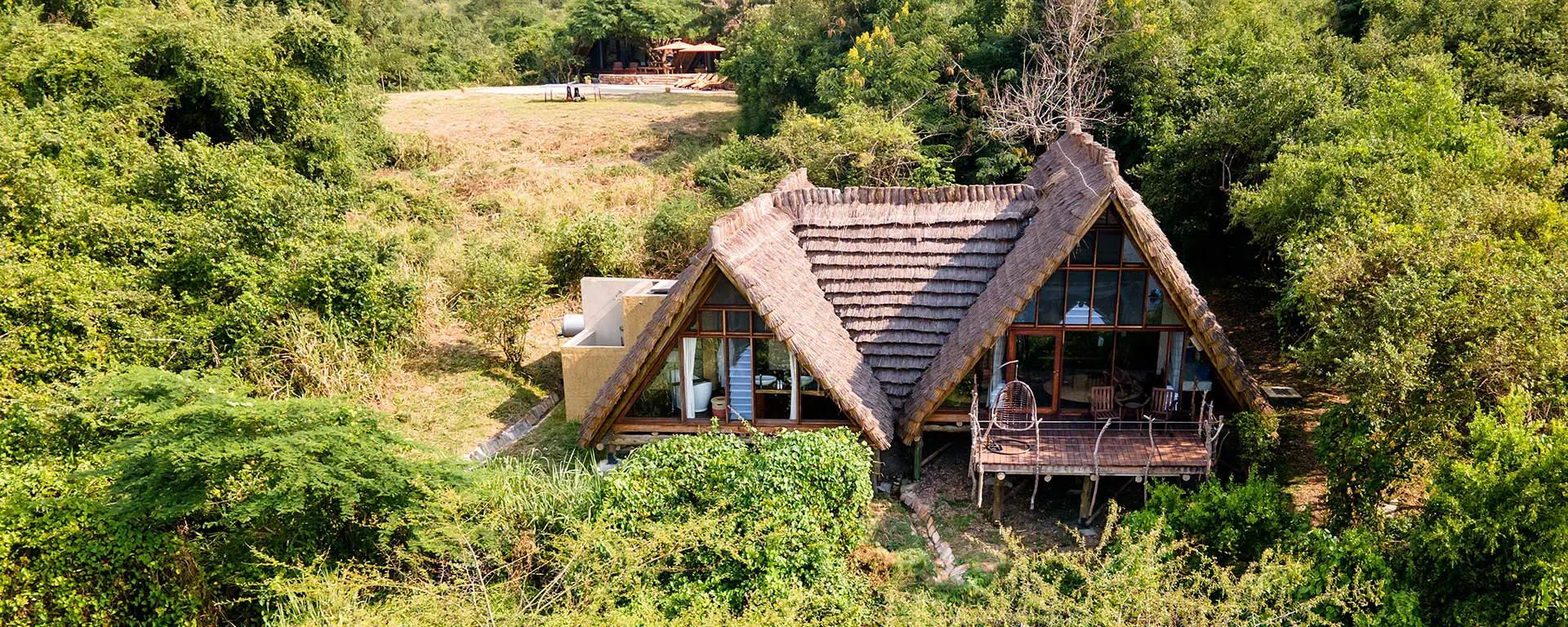
1 hand-picked glamping stay in and around the park.

Murchison Falls National Park guide
Overview
Murchison Falls National Park is Uganda’s largest national park, covering about 3,893 km² in the north-west of the country. It was gazetted in 1952. The Victoria Nile runs through the middle of the park, and at Murchison Falls the entire river squeezes through a gap in the rock about seven metres wide before dropping into the valley below.
The river divides the park. To the north, the Buligi area is open savanna and borassus palm grassland, where game drives find giraffe, elephant, buffalo, lion and many antelope. To the south, the land rises into woodland and the Budongo Forest, known for its chimpanzees.
The best-known experience is the launch trip from Paraa up the river towards the base of the falls. Hippos, crocodiles and elephants line the banks, and the birding is superb. You can also hike to the top of the falls, take a boat to the delta where the Nile meets Lake Albert to look for shoebills, or go sport fishing.
Accommodation ranges from campsites and mid-range lodges near Paraa to smart riverside lodges and tented camps. Murchison combines well with Kibale and Queen Elizabeth further south.
Wildlife & Biodiversity
Big game
Elephant, buffalo and lion are found on the northern savannas, and leopard are present throughout. The park has a large population of Rothschild’s giraffe, and Uganda kob, Jackson’s hartebeest, oribi, waterbuck and warthog are common.
Primates
Chimpanzees live in the Budongo Forest and the Kaniyo Pabidi area in the south of the park, where tracking is possible. Olive baboons, black-and-white colobus and red-tailed monkeys are also seen.
River and birds
The Nile holds large numbers of hippo and Nile crocodile. More than 450 bird species have been recorded, and the papyrus swamps of the delta are one of the best places in Uganda to look for the shoebill.
Best Time to Visit
Short answer: December to February and June to September, during the drier seasons, when game drives are easier.
| Months | Season | What to expect |
|---|---|---|
| Dec – Feb | Main dry season | Hot and dry. Grass is short and game viewing is at its best. |
| Mar – May | Long rains | Heavy rain at times, lush scenery and good birding. Some tracks become muddy. |
| Jun – Sep | Drier season | Good game viewing and comfortable temperatures. |
| Oct – Nov | Short rains | Showers, fewer visitors and green landscapes. |
Murchison is a malaria and tsetse fly area. Wear neutral colours, use repellent and take malaria prophylaxis.
Getting There
By air
| Airport | Best for | Notes |
|---|---|---|
| Entebbe International (EBB) | International arrivals | About 6 to 7 hours by road. |
| Pakuba and Bugungu airstrips | Fly-in safaris | Scheduled and charter flights from Entebbe and Kajjansi. |
By road
From Kampala, drive north to Masindi, about four hours, then continue to the park’s southern gates and down to Paraa on the Nile. A vehicle ferry crosses the river at Paraa to reach the northern game-viewing area. Allow a full day from Entebbe or Kampala.
Entrance & Fees
Uganda Wildlife Authority charges a park entrance fee per person, valid for 24 hours. Activities such as the launch trip, game drives and chimpanzee tracking are charged separately.
| Visitor | Adult | Child (5–15) |
|---|---|---|
| Foreign non-resident | US$45 | US$25 |
| Foreign resident | US$35 | US$15 |
| Rest of Africa | US$30 | US$10 |
| East African citizen | UGX 25,000 | UGX 10,000 |
Children under five enter free. Vehicle entry is charged separately. The launch trip to the bottom of the falls is US$30 for foreign non-residents.
Fees last checked October 2026 against the UWA Conservation Tariff (July 2024 to June 2026).
