

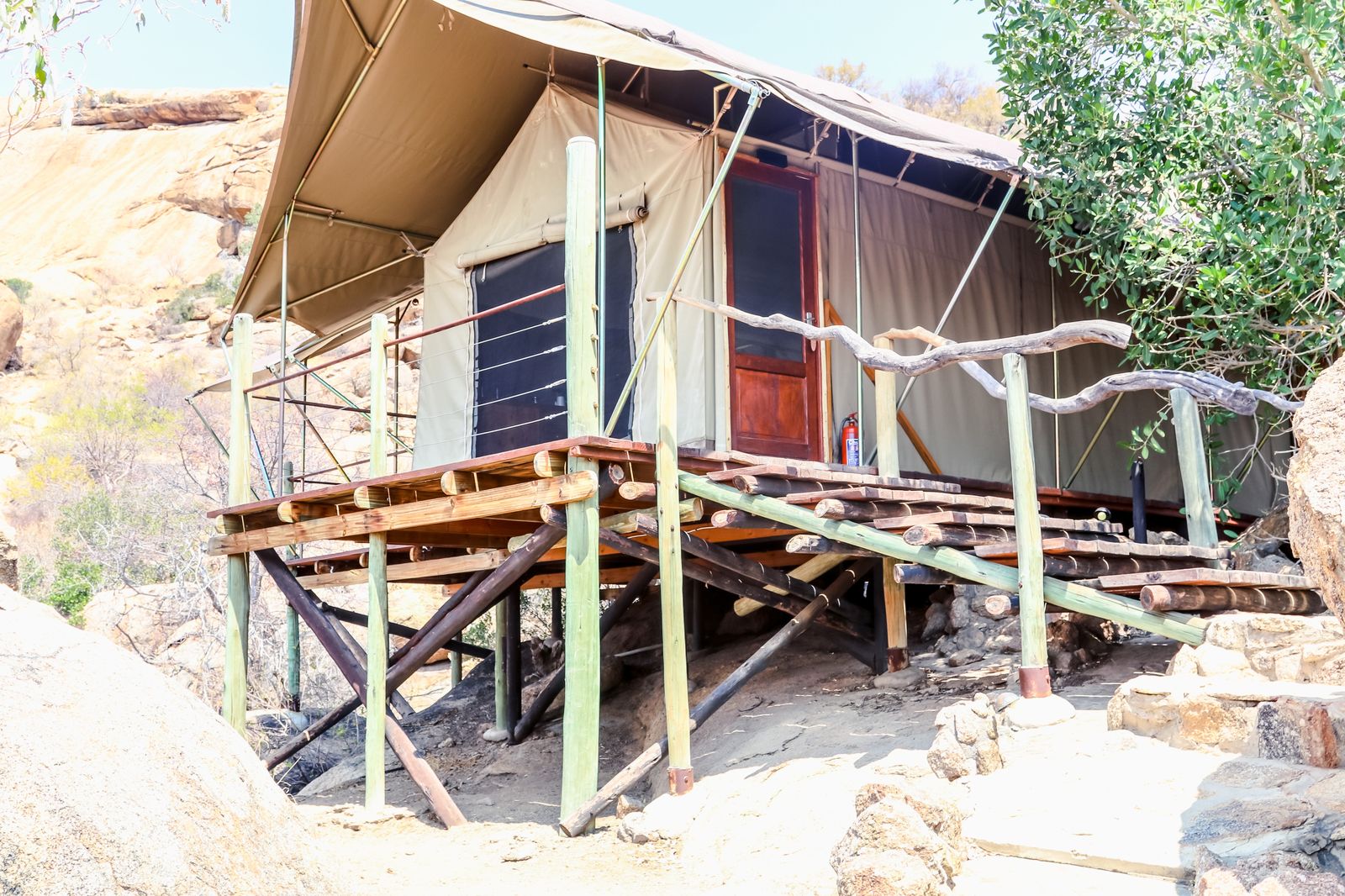
Where to stay in Erongo Mountain Nature Conservancy
1 hand-picked glamping stay in and around the park.

Erongo Mountain Nature Conservancy guide
Overview
The Erongo Mountain Nature Conservancy, now known as the Erongo Mountain Nature Sanctuary, protects around 160,000 hectares of the Erongo Mountains in west-central Namibia, west of Omaruru and north of Karibib. It is about three hours’ drive from Windhoek, making it one of the easiest wild areas to reach from the capital.
The Erongo is the eroded remains of a huge volcano that formed during the break-up of the supercontinent Gondwana, more than 130 million years ago. What is left is a ring of granite domes, boulder fields and hidden valleys rising out of the surrounding savanna. In 1998, a group of landowners decided to manage their farms together as one conservation area. The conservancy was formally established in 2000. In 2008, a trust was set up to bring black rhino back to the mountains under the government’s Black Rhino Custodianship Programme.
Erongo is a place for walking, scrambling and slow game drives rather than big-game safaris. The rocks hold some of Namibia’s finest rock art, including the famous Phillip’s Cave with its white elephant painting. The birding is excellent, and the light on the granite at sunrise and sunset is a photographer’s dream.
Accommodation is in a small number of lodges, guest farms and tented camps spread across the private land, many with their own hiking trails and guided drives. It works well as the first or last stop on a Namibia self-drive, between Windhoek and Etosha or the coast at Swakopmund.
Wildlife & Biodiversity
Black rhino
Black rhino were reintroduced from 2008 and now roam the mountains. Sightings are not guaranteed and are usually made on guided drives or tracking walks, depending on your lodge.
Mountain mammals
Hartmann’s mountain zebra, kudu, gemsbok, eland, klipspringer, steenbok, Damara dik-dik and rock hyrax live here. Leopard and brown hyena are present but elusive. Look out for the dassie rat, a small rodent found only in rocky areas of Namibia.
Birds
Erongo is one of the best places in the country for Namibian near-endemics. Highlights include Hartlaub’s francolin, rosy-faced lovebird, Monteiro’s and Damara hornbills, white-tailed shrike, Herero chat, rockrunner and Rüppell’s parrot.
Best Time to Visit
Short answer: April to October for dry, sunny weather. Winter is ideal for hiking.
| Months | Season | What to expect |
|---|---|---|
| Apr – May | Late summer to autumn | Green after the rains, with pleasant temperatures and good birding. |
| Jun – Aug | Cool dry season | Sunny days and cold nights, sometimes near freezing. The best time for walking and climbing. |
| Sep – Oct | Hot dry season | Warm to hot days. Wildlife gathers at water points. |
| Nov – Mar | Rain season | Hot, with afternoon thunderstorms, mostly January to March. Landscapes turn green, and migrant birds arrive. |
Erongo is malaria-free, which makes it a good choice for families.
Getting There
By air
| Airport | Best for | Notes |
|---|---|---|
| Hosea Kutako International (WDH), Windhoek | International arrivals and self-drive | About three hours by road to Omaruru. |
| Windhoek Eros (ERS) | Charter flights | Some lodges have airstrips or can arrange charter flights. |
By road
From Windhoek, take the B1 north to Okahandja and the B2 west towards Karibib, then turn north onto the C33 to Omaruru. From Omaruru, lodges in the Erongo are reached on gravel roads such as the D2315 and D2316, with farm tracks to the final destination. A normal car can manage the main gravel roads in dry weather; check with your lodge for the last stretch.
Entrance & Fees
Erongo is private land, and there is no public entry fee. Access is for guests of the lodges and guest farms within the conservancy, and conservation contributions are included in the nightly rate.
Guided rhino tracking and rock art excursions are priced separately by each lodge.
Fees last checked October 2026 against the Erongo Mountain Nature Sanctuary website.